

Your cart is empty.
Continue ShoppingResearch
•Skin Microbiome
•Your arms, ears and toes host different bacteria
Each area of skin carried its own mix of bacteria in a 2023 study of 129 healthy young adults. Dry areas like the forearms and calves had the most variety. The face was not sampled.

Contents of this article
Key takeaways from this article
- Scientists swabbed five areas of skin on 129 healthy young adults.
- Each type of skin, whether oily, damp or dry, had its own mix of bacteria.
- The dry areas, the forearms and calves, had the widest variety of bacteria.
- Age, gender and ethnicity made no clear difference in this group.
- The face was not sampled.
Is the skin on your arms home to the same bacteria as the skin behind your ears? No. A 2023 study in Frontiers in Microbiology found that each area of skin, whether oily, damp or dry, carried its own mix of bacteria. The dry skin on the forearms and calves had the most variety.
What the scientists did
Your skin is home to a busy community of tiny living things, called the skin microbiome.
The team worked with 129 healthy students at a US university. Their average age was about 24. Each person swabbed five spots on their own skin, just once.
The spots were picked because they differ. Behind the ears is oily. The belly button and the gaps between the toes are warm and damp. The forearms and calves are dry.
The team then read the bacterial DNA in each sample to see who lived where. People joined in four different years, from 2019 to 2023.
What they found
Each area had its own crowd. The mix of bacteria was clearly different on oily, damp and dry skin. Spots of the same type, like the forearms and calves, looked the most alike.
Two groups led overall. These were common skin bacteria called Staphylococcus and Corynebacterium. Behind the ears, about 7 in 10 of the bacteria found were Staphylococcus.
Dry skin had the most variety. The forearms and calves carried the richest and most even mix. The skin between the toes had the least.
Where mattered more than who. In this group, age, gender and ethnicity made no clear difference.
The years differed, but that is hard to read. Samples from some years differed from others. But different people took part each year, so the team could not tell if skin changes over time.
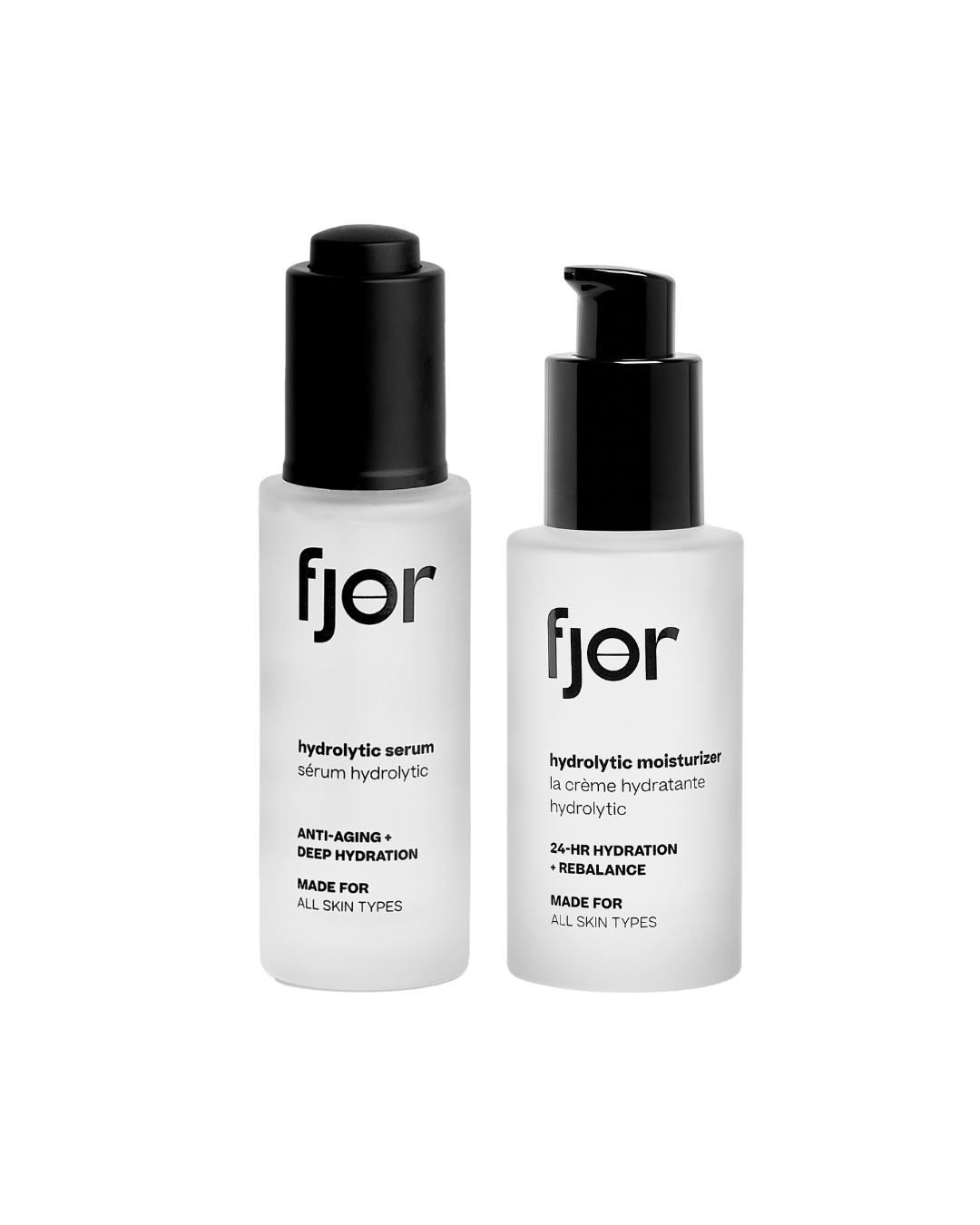
The Face Routine
Hydrolytic® Serum + Moisturizer
What this means for your skin
This study suggests your skin is not one habitat. It is more like a map of small neighborhoods, each shaped by how oily, damp or dry it is.
So the skin on your arms and legs may have different needs from the skin behind your ears. The authors also say washing habits and skin care products may affect each area in its own way. They did not test this.
What we still don't know
- The face was not sampled, so we cannot say how facial skin compares.
- Everyone was a healthy student, mostly young, in one US city.
- Each person gave samples only once, so the study cannot show how one person's skin changes over time.
- The DNA test used can miss some common skin bacteria.
Why this matters to fjör
Forearms and calves in this study carried a wider, more even spread of bacteria than the oily skin behind the ears. Below the neck, one patch of skin is not a copy of the next. The study did not test fjör, and faces were never sampled.
So we think body skin deserves care of its own, not leftovers from a face routine. Hydrolytic® Body brings our enzyme to your arms, legs and torso. On every patch of skin, the goal stays the same: support the local community that is already there.
Frequently asked questions
Is the skin microbiome the same all over the body?
No. In this study, oily, damp and dry areas each carried their own mix of bacteria.
Which part of the skin has the most types of bacteria?
The dry areas. The forearms and calves had the richest mix of the five spots tested.
Do age or gender change which bacteria live on skin?
Not clearly in this group of healthy young adults. Where on the body the sample came from mattered much more.
References
- Pérez-Losada M, Crandall KA. Spatial diversity of the skin bacteriome. Frontiers in Microbiology. 2023;14:1257276. https://doi.org/10.3389/fmicb.2023.1257276


